Total flooding systems
Discharge a calculated quantity of CO₂ into an enclosure to establish and maintain the required concentration. Enclosure integrity, openings, leakage, ventilation shutdown and safe evacuation are central design considerations.
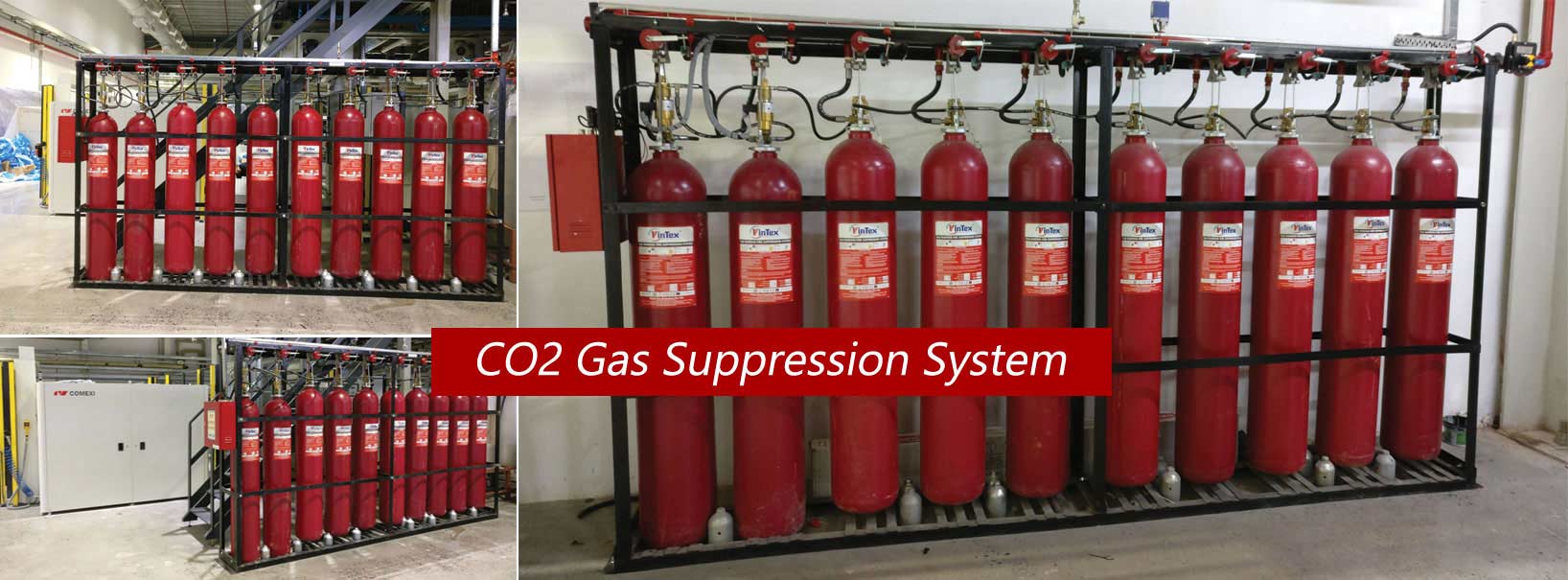
Design, supply, installation, testing, commissioning and maintenance of carbon-dioxide total flooding and local application systems for suitable industrial hazards across India.
A CO₂ fire suppression system is a fixed extinguishing system that releases carbon dioxide into an enclosure or directly over a hazard to reduce the conditions that sustain combustion.
Carbon dioxide is electrically nonconductive and leaves no residue. It can protect suitable electrical, mechanical, flammable-liquid and industrial process hazards where cleanup from water, foam or powder would be difficult.
The system normally includes agent storage, valves, a detection and control arrangement, discharge piping, nozzles, alarms, manual controls, shutdown interfaces and clearly defined safety procedures.
CO₂ extinguishing concentrations can cause unconsciousness or death. A CO₂ system must never be selected or installed without competent engineering, occupancy review, evacuation provisions, pre-discharge warning, supervised lockout, restricted re-entry, ventilation and trained maintenance procedures.
Discharge a calculated quantity of CO₂ into an enclosure to establish and maintain the required concentration. Enclosure integrity, openings, leakage, ventilation shutdown and safe evacuation are central design considerations.
Direct CO₂ through arranged nozzles onto a particular machine, surface or process hazard where a full enclosure is not used. Discharge rate, coverage geometry and surrounding personnel risks require careful analysis.
Agent may be stored in high-pressure cylinders or suitable refrigerated low-pressure storage for larger installations. Capacity, redundancy, space, access, ambient conditions and maintenance needs influence selection.
Cylinders, manifolds, supports, valves, weighing or level supervision and suitable storage-room provisions.
Detection devices, releasing panel, cause-and-effect logic, manual release, abort where applicable and fault supervision.
Engineered piping, selector valves, fittings, supports and nozzles sized for the required discharge.
Distinctive audible and visual pre-discharge alarms, entrance warnings and status indication.
Supervised isolation or lockout arrangements to prevent discharge while personnel are exposed during work or maintenance.
Ventilation, fuel, electrical or process shutdowns required by the approved cause-and-effect sequence.
Enclosure pressure-relief and leakage provisions evaluated for the system discharge and protected construction.
Restricted entry, atmospheric assessment, extraction or ventilation and authorised reset procedures.
Most serious CO₂ incidents are associated with unintended exposure, including maintenance and testing activities. Safety controls must remain functional throughout the system lifecycle.
Determine who can enter the protected space, adjacent areas, pits, trenches, storage rooms and any location where gas can accumulate.
Provide a distinctive warning and sufficient evacuation time before automatic discharge where required by the approved design.
Mark protected areas, entrances, controls and storage locations with clear CO₂ hazard and evacuation instructions.
Isolate release capability during maintenance or when personnel could be exposed, using controlled and supervised procedures.
Prevent unsafe entry after discharge until the atmosphere has been assessed and the space has been safely ventilated.
Train affected personnel on alarms, evacuation routes, system controls, maintenance hazards and emergency response limitations.
Suitability depends on the fire hazard, enclosure, occupancy and approved risk assessment. The following are examples—not automatic recommendations.
The correct agent is chosen through fire-risk, occupancy, equipment, environmental, approval and business-continuity considerations.
| Technology | Key characteristic | Personnel consideration | Typical decision factor |
|---|---|---|---|
| CO₂ suppression | Residue-free and electrically nonconductive | Extinguishing concentrations are dangerous; strict safeguards are essential | Suitable industrial or normally unoccupied special hazards |
| Clean-agent suppression | Residue-free gaseous protection | Occupancy limits and agent-specific exposure criteria still apply | Sensitive equipment and occupiable critical rooms where approved |
| Water mist | Fine droplets absorb heat with reduced water demand in suitable applications | Generally avoids an asphyxiant atmosphere, but hazard compatibility matters | Approved machinery, marine, heritage or enclosure applications |
| Sprinkler / water spray | Established cooling, control and exposure protection | Water damage and electrical/process compatibility must be evaluated | Buildings, storage, process areas and equipment protection |
Assess fuel, equipment, enclosure, people, access, adjacent spaces and safer alternatives.
Define application method, agent quantity, discharge criteria, safety controls and approval requirements.
Coordinate storage, piping, nozzles, detection, release logic, alarms, shutdowns and documentation.
Perform prescribed inspections, functional tests, cause-and-effect checks, training and records.
Support cylinder checks, release controls, alarms, interlocks, lockout procedures and periodic servicing.
CO₂ systems should be designed and installed by competent fire-protection professionals in accordance with the applicable authority requirements, client specifications, insurer criteria and recognised standards specified for the project, including NFPA 12 where adopted.
Design must address agent quantity, enclosure leakage, discharge duration, nozzle flow, storage conditions, piping strength, detection, release logic, alarms, evacuation, lockout, ventilation, signage, pressure effects, testing and maintenance access.
Important: This page provides general information only. It is not a design calculation, approval document or permission to use CO₂ in an occupied or occupiable space.
Vintex accepts enquiries from all 28 states and 8 union territories. Cities listed below are principal industrial and service locations; surrounding cities and districts may be supported based on hazard suitability, scope and logistics.
Visakhapatnam, Vijayawada, Guntur, Tirupati, Nellore, Kurnool, Rajahmundry and Kakinada.
Itanagar, Naharlagun, Pasighat, Tawang, Ziro and Bomdila.
Guwahati, Dibrugarh, Silchar, Jorhat, Tezpur, Tinsukia and Nagaon.
Patna, Gaya, Muzaffarpur, Bhagalpur, Darbhanga, Purnia and Bihar Sharif.
Raipur, Bhilai, Durg, Bilaspur, Korba, Raigarh and Jagdalpur.
Panaji, Margao, Vasco da Gama, Mapusa and Ponda.
Ahmedabad, Surat, Vadodara, Rajkot, Gandhinagar, Bharuch, Vapi, Jamnagar and Bhavnagar.
Gurugram, Faridabad, Panipat, Sonipat, Ambala, Karnal, Hisar and Manesar.
Shimla, Dharamshala, Solan, Baddi, Mandi, Kullu and Una.
Ranchi, Jamshedpur, Dhanbad, Bokaro, Deoghar and Hazaribagh.
Bengaluru, Mysuru, Mangaluru, Hubballi-Dharwad, Belagavi, Ballari, Tumakuru and Davanagere.
Thiruvananthapuram, Kochi, Kozhikode, Thrissur, Kollam, Kannur, Alappuzha and Palakkad.
Indore, Bhopal, Jabalpur, Gwalior, Ujjain, Sagar, Satna and Dewas.
Mumbai, Thane, Navi Mumbai, Pune, Nagpur, Nashik, Chhatrapati Sambhajinagar, Kolhapur, Solapur, Palghar and Raigad.
Imphal, Thoubal, Bishnupur and Churachandpur.
Shillong, Tura, Jowai and Nongpoh.
Aizawl, Lunglei, Champhai and Kolasib.
Dimapur, Kohima, Mokokchung and Wokha.
Bhubaneswar, Cuttack, Rourkela, Sambalpur, Berhampur, Puri, Balasore and Jharsuguda.
Ludhiana, Amritsar, Jalandhar, Mohali, Patiala, Bathinda and Pathankot.
Jaipur, Jodhpur, Udaipur, Kota, Ajmer, Bikaner, Alwar, Neemrana and Bhilwara.
Gangtok, Namchi, Gyalshing, Mangan and Rangpo.
Chennai, Coimbatore, Madurai, Tiruchirappalli, Salem, Tiruppur, Hosur, Vellore and Thoothukudi.
Hyderabad, Secunderabad, Warangal, Karimnagar, Nizamabad, Khammam and Sangareddy.
Agartala, Udaipur, Dharmanagar and Kailasahar.
Lucknow, Noida, Greater Noida, Ghaziabad, Kanpur, Agra, Varanasi, Prayagraj, Meerut, Gorakhpur and Bareilly.
Dehradun, Haridwar, Roorkee, Haldwani, Rudrapur and Rishikesh.
Kolkata, Howrah, Durgapur, Asansol, Siliguri, Haldia and Kharagpur.
Port Blair and other project locations across the islands, subject to logistics.
Chandigarh, Mohali, Panchkula and the adjoining Tricity region.
Silvassa, Daman and Diu.
New Delhi, Central Delhi, North Delhi, South Delhi, East Delhi, West Delhi and NCR project locations.
Srinagar, Jammu, Anantnag, Baramulla, Kathua and Udhampur.
Leh and Kargil, subject to project conditions and logistics.
Kavaratti and other project locations, subject to logistics.
Puducherry, Karaikal, Mahe and Yanam.
Use these answers as orientation only. Final decisions require a qualified site and hazard assessment.
CO₂ suppresses combustion by reducing the oxygen concentration and the fuel-vapour concentration around the fire. The required design and discharge depend on the hazard and application method.
No. Although CO₂ is residue-free and electrically nonconductive, extinguishing concentrations are dangerous to people. It must not be described or selected as though it has the same human-exposure characteristics as a clean agent.
CO₂ presents a severe exposure hazard. Occupancy and safer alternatives must be assessed, and any permitted design requires robust evacuation, alarm, delay, lockout, signage, access and ventilation safeguards.
It releases a calculated quantity of CO₂ throughout an enclosure to establish an extinguishing concentration. Enclosure integrity, opening closure, ventilation shutdown and safe egress are essential.
It directs CO₂ onto a defined hazard through engineered nozzles without relying on a complete enclosure. The design must account for hazard geometry, airflow, discharge rate and personnel exposure.
Maintenance includes storage quantity or weight checks, cylinder and valve inspection, piping and nozzle condition, detection, alarms, release and lockout controls, shutdown interlocks, signage and documented functional testing.
Yes. Vintex considers CO₂ suppression enquiries across India, subject to hazard suitability, occupancy review, site information, project scope and logistics.
Provide the site location, protected equipment, fuel or process, enclosure dimensions, occupancy pattern, drawings and required scope through the Vintex contact page.
Share the protected equipment, occupancy, enclosure and project location with the Vintex team.
