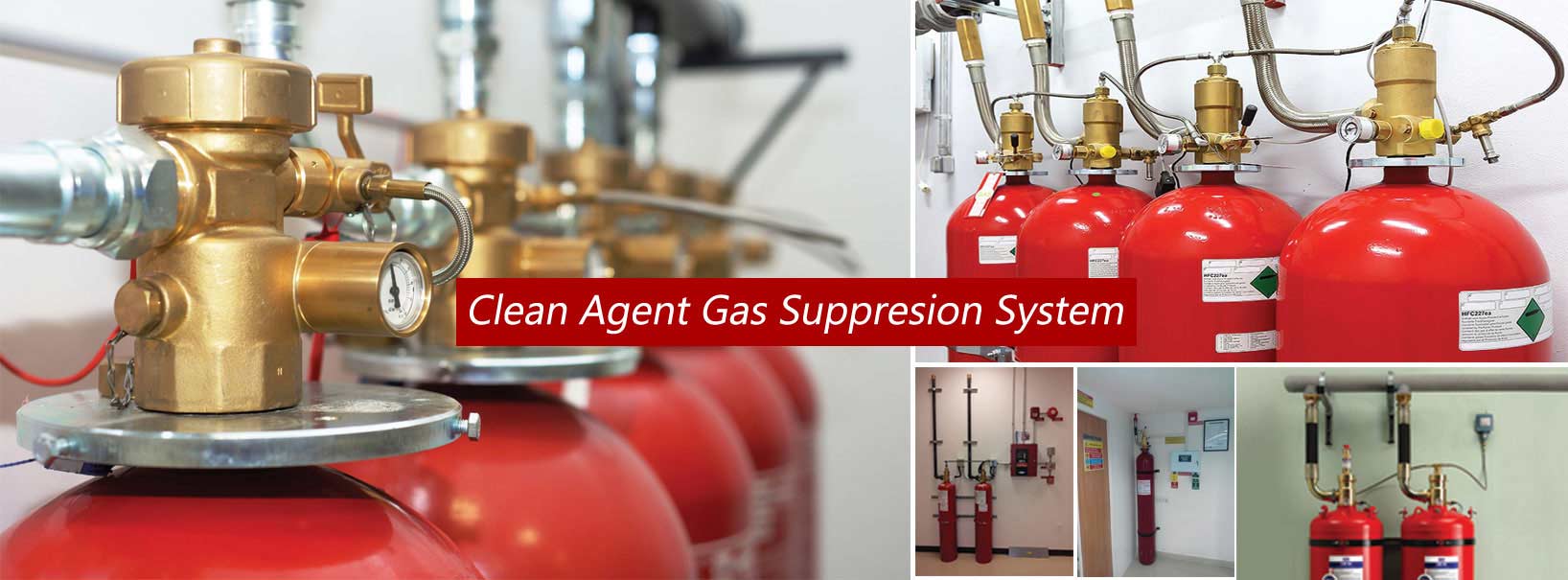
Clean agent gas fire suppression cylinders and engineered system
Residue-free critical asset protection

Clean Agent Fire Suppression Systems

Engineered halocarbon and inert-gas total-flooding systems for suitable data centres, electrical rooms, control rooms, archives and critical assets across India.

No extinguishing residueDesigned for sensitive assets
Engineered concentrationHazard and enclosure specific
Detection integrationAlarm, delay and releasing logic
Pan-India supportProjects and lifecycle service
Direct answer

What is a clean agent fire suppression system?

A clean agent system rapidly discharges an electrically non-conductive gaseous agent that leaves no residue after evaporation.

In a total-flooding application, detection and releasing controls discharge a calculated agent quantity through engineered piping and nozzles into an enclosure. The room must achieve the specified concentration and retain it for the approved hold time.

Clean agents are often selected where water or powder cleanup could damage electronics, data, documents or high-value equipment. They supplement—not replace—fire detection, alarm, compartmentation, emergency procedures and any other protection required by the approved design.

Selection note: “Clean” means the agent leaves no residue; it does not mean every agent is environmentally identical or safe at every concentration. Suitability must be engineered.
Agent families

Halocarbon and inert-gas clean agents

Halocarbon systems

Compact storage and rapid discharge

Agents such as HFC-227ea or FK-5-1-12 may be considered where permitted, available and supported by the listed system. They primarily suppress fire through heat absorption and chemical or physical effects.

  • Typically lower storage volume than inert gas
  • Electrically non-conductive and residue-free
  • Exposure and decomposition-product risks must be evaluated
  • Environmental profile and regulatory lifecycle vary by agent
Inert-gas systems

Atmospheric gases and blends

Agents such as IG-100, IG-55, IG-541 and IG-01 use nitrogen, argon, carbon dioxide in approved blends, or combinations, to reduce oxygen to a design level that suppresses combustion.

  • Zero ozone-depletion potential for recognised inert agents
  • Often requires more cylinder space and higher-pressure storage
  • Vent area and enclosure pressure must be engineered
  • Occupant exposure and egress remain design-critical
Explore INERGEN / IG-541 systems →
System architecture

Core components of a clean agent system

01

Agent cylinders

Approved containers, valves, actuators, monitoring and restraints sized for the protected volume.

02

Detection

Compatible smoke, aspirating or other detection arranged for the approved release strategy.

03

Releasing panel

Supervised cross-zone logic, alarms, time delay, manual release, abort and shutdown interfaces.

04

Piping and nozzles

Hydraulically calculated pipe sizes, fittings, supports and discharge nozzles within listed limits.

05

Room integrity

Boundary sealing, door-fan testing, hold-time evaluation and protected-volume verification.

06

Pressure relief

Engineered venting where required to limit enclosure pressure during agent discharge.

07

Warning devices

Pre-discharge and discharge sounders, strobes, signage and status indication for occupants.

08

Interlocks

HVAC shutdown, damper closure, power or process isolation and other approved cause-and-effect actions.

Turnkey delivery

How a clean agent project is engineered

01

Hazard survey

Confirm fire classes, occupancy, equipment, room volume, voids, openings and ventilation.

02

Agent selection

Compare suitability, exposure limits, space, pressure, environment, approvals and lifecycle support.

03

System calculation

Determine design concentration, agent quantity, piping, nozzles, discharge time and reserve strategy.

04

Controls and interfaces

Develop detection zones, release sequence, alarms, delay, abort, shutdowns and cause-and-effect logic.

05

Testing and handover

Verify pressure, devices, logic, interfaces, room integrity, records and user procedures.

Suitable enclosed hazards

Where are clean agent systems used?

Data centresServer roomsNetwork roomsUPS rooms Electrical roomsControl roomsTelecommunication facilitiesMedical equipment rooms Archives and recordsMuseums and collectionsLaboratoriesClean rooms Marine machinery spacesProcess control centresGenerator enclosuresHigh-value equipment
Selection guidance

Clean agent, CO₂, water mist or aerosol?

SystemPrimary strengthKey constraintTypical decision factor
Clean agentResidue-free, electrically non-conductive total floodingEnclosure integrity, exposure and agent lifecycleSensitive equipment in a suitable enclosed volume
CO₂Effective gaseous suppression with no residueLife-safety risk at extinguishing concentrationsNormally unoccupied or tightly controlled hazards
Water mistCooling with comparatively low water demandApplication-specific testing and nozzle coverageFire scenario, water tolerance and listing
Condensed aerosolCompact units and limited piping in suitable applicationsResidue, visibility, temperature and application limitsSmall enclosures and approved equipment hazards
Safety and compliance

Designed around IS 15493 and NFPA 2001 principles

Indian projects may reference IS 15493 for gaseous fire-extinguishing systems, project specifications, local fire-authority requirements and the current applicable edition of NFPA 2001 or ISO 14520.

The design must address occupied or unoccupied status, agent exposure limits, egress, pre-discharge warning, time delay, abort and manual release, enclosure leakage, pressure relief, pipework, detection reliability, shutdowns, electrical isolation, decomposition products and post-discharge ventilation.

Important: Clean agents are not automatically suitable for every combustible material, deep-seated fire, reactive substance or battery hazard. The specific fire scenario and listed system limitations must be reviewed by qualified professionals.

Pan-India coverage

Clean agent suppression systems across India

Vintex accepts enquiries from all 28 states and 8 union territories. Cities listed are principal industrial and service locations; surrounding districts may be supported based on hazard, enclosure data, scope, approvals and logistics.

Andhra Pradesh

Visakhapatnam, Vijayawada, Guntur, Tirupati, Nellore, Kurnool, Rajahmundry and Kakinada.

Arunachal Pradesh

Itanagar, Naharlagun, Pasighat, Tawang, Ziro and Bomdila.

Assam

Guwahati, Dibrugarh, Silchar, Jorhat, Tezpur, Tinsukia and Nagaon.

Bihar

Patna, Gaya, Muzaffarpur, Bhagalpur, Darbhanga, Purnia and Bihar Sharif.

Chhattisgarh

Raipur, Bhilai, Durg, Bilaspur, Korba, Raigarh and Jagdalpur.

Goa

Panaji, Margao, Vasco da Gama, Mapusa and Ponda.

Gujarat

Ahmedabad, Surat, Vadodara, Rajkot, Gandhinagar, Bharuch, Vapi, Jamnagar and Bhavnagar.

Haryana

Gurugram, Faridabad, Panipat, Sonipat, Ambala, Karnal, Hisar and Manesar.

Himachal Pradesh

Shimla, Dharamshala, Solan, Baddi, Mandi, Kullu and Una.

Jharkhand

Ranchi, Jamshedpur, Dhanbad, Bokaro, Deoghar and Hazaribagh.

Karnataka

Bengaluru, Mysuru, Mangaluru, Hubballi-Dharwad, Belagavi, Ballari, Tumakuru and Davanagere.

Kerala

Thiruvananthapuram, Kochi, Kozhikode, Thrissur, Kollam, Kannur, Alappuzha and Palakkad.

Madhya Pradesh

Indore, Bhopal, Jabalpur, Gwalior, Ujjain, Sagar, Satna and Dewas.

Maharashtra

Mumbai, Thane, Navi Mumbai, Pune, Nagpur, Nashik, Chhatrapati Sambhajinagar, Kolhapur, Solapur, Palghar and Raigad.

Manipur

Imphal, Thoubal, Bishnupur and Churachandpur.

Meghalaya

Shillong, Tura, Jowai and Nongpoh.

Mizoram

Aizawl, Lunglei, Champhai and Kolasib.

Nagaland

Dimapur, Kohima, Mokokchung and Wokha.

Odisha

Bhubaneswar, Cuttack, Rourkela, Sambalpur, Berhampur, Puri, Balasore and Jharsuguda.

Punjab

Ludhiana, Amritsar, Jalandhar, Mohali, Patiala, Bathinda and Pathankot.

Rajasthan

Jaipur, Jodhpur, Udaipur, Kota, Ajmer, Bikaner, Alwar, Neemrana and Bhilwara.

Sikkim

Gangtok, Namchi, Gyalshing, Mangan and Rangpo.

Tamil Nadu

Chennai, Coimbatore, Madurai, Tiruchirappalli, Salem, Tiruppur, Hosur, Vellore and Thoothukudi.

Telangana

Hyderabad, Secunderabad, Warangal, Karimnagar, Nizamabad, Khammam and Sangareddy.

Tripura

Agartala, Udaipur, Dharmanagar and Kailasahar.

Uttar Pradesh

Lucknow, Noida, Greater Noida, Ghaziabad, Kanpur, Agra, Varanasi, Prayagraj, Meerut, Gorakhpur and Bareilly.

Uttarakhand

Dehradun, Haridwar, Roorkee, Haldwani, Rudrapur and Rishikesh.

West Bengal

Kolkata, Howrah, Durgapur, Asansol, Siliguri, Haldia and Kharagpur.

Andaman and Nicobar Islands

Port Blair and other project locations across the islands, subject to logistics.

Chandigarh

Chandigarh, Mohali, Panchkula and the adjoining Tricity region.

Dadra and Nagar Haveli and Daman and Diu

Silvassa, Daman and Diu.

Delhi (NCT)

New Delhi, Central Delhi, North Delhi, South Delhi, East Delhi, West Delhi and NCR project locations.

Jammu and Kashmir

Srinagar, Jammu, Anantnag, Baramulla, Kathua and Udhampur.

Ladakh

Leh and Kargil, subject to project conditions and logistics.

Lakshadweep

Kavaratti and other project locations, subject to logistics.

Puducherry

Puducherry, Karaikal, Mahe and Yanam.
Frequently asked questions

Clear answers about clean agent systems

Final agent and system selection requires verified hazard, occupancy and enclosure data.

Does clean agent damage electronics?

Clean agents are electrically non-conductive and leave no extinguishing residue, making them useful for suitable energised equipment. Fire damage, heat, smoke and agent decomposition products still require consideration.

What is a room integrity test?

A calibrated door-fan test estimates leakage from the protected enclosure and predicts whether the design concentration can remain for the required hold time.

Are FM-200 and HFC-227ea the same?

FM-200 is a trade name associated with the agent HFC-227ea. Specifications should identify the generic agent, listed system, approvals and lifecycle requirements instead of relying only on a brand name.

What happens before clean agent discharge?

A typical approved sequence uses confirmed detection, audible and visual warning, a time delay and required shutdowns before automatic discharge. Manual release and abort functions depend on the approved design.

Can clean agent protect lithium-ion batteries?

Do not assume so. Battery fire and thermal-runaway scenarios require application-specific evaluation, testing, detection, ventilation and possibly other suppression or cooling measures.

How often should the system be maintained?

Inspection and testing intervals follow the applicable standard, manufacturer instructions and authority requirements. Checks cover cylinders, pressure or weight, valves, piping, nozzles, detection, release logic, alarms, interfaces and enclosure changes.

Does Vintex execute projects outside Maharashtra?

Yes. Vintex considers clean agent projects across India, subject to hazard suitability, enclosure details, project specifications, agent availability, approvals and logistics.

What information is needed for a quotation?

Share room dimensions, raised-floor and ceiling voids, occupancy, equipment, hazard type, ventilation, openings, drawings, applicable standards, required interfaces, project location and any preferred agent.

Protecting a critical room or asset?

Share the enclosure, hazard, occupancy and project location with the Vintex team.

Request a consultation →