Residue-free discharge
No powder, foam or extinguishing liquid remains on protected equipment after the gas is ventilated.
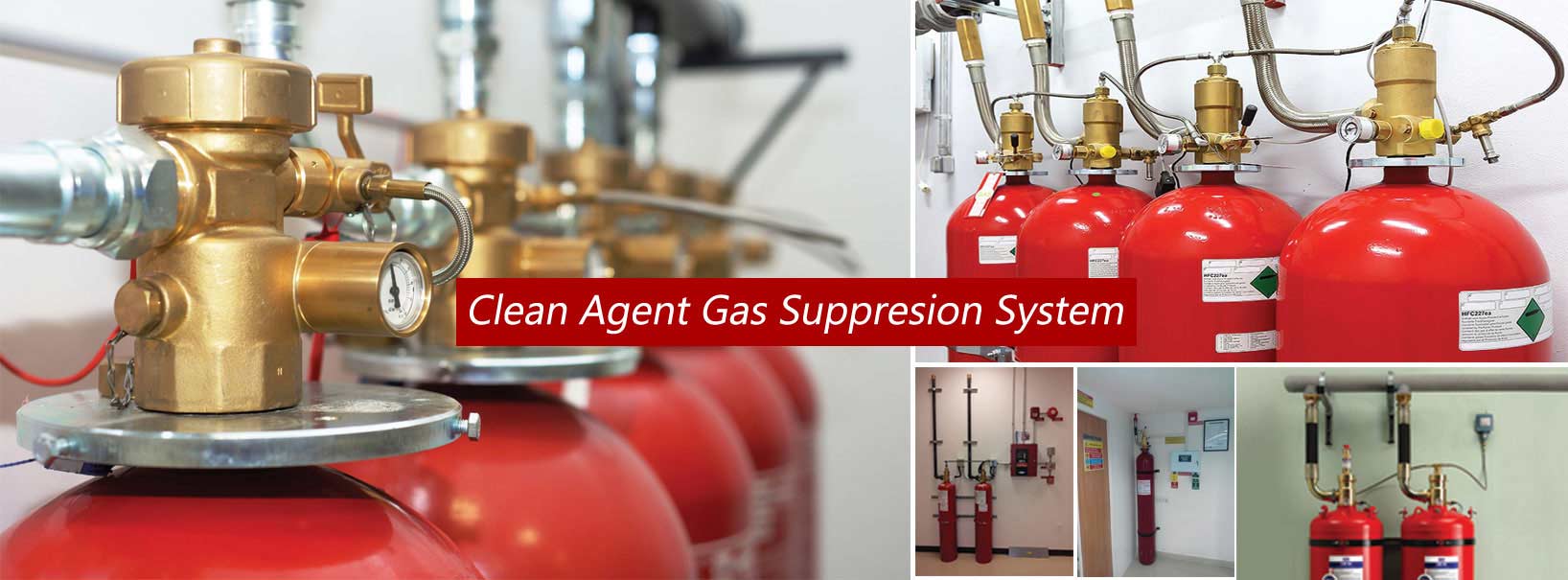
Design, supply, installation, testing, commissioning and maintenance of IG-541 total-flooding systems for suitable critical enclosures across India.
IG-541 is a clean, electrically non-conductive inert-gas blend that suppresses fire by reducing oxygen in a protected enclosure to an engineered concentration.
The agent is nominally 52% nitrogen, 40% argon and 8% carbon dioxide by volume. A total-flooding system stores the gas in high-pressure cylinders and distributes a calculated quantity through piping and nozzles after confirmed detection and the approved release sequence.
Because the gases occur naturally in the atmosphere and leave no residue, IG-541 is often considered for sensitive equipment and high-value assets. Its larger storage volume, high-pressure hardware, enclosure pressure and occupant exposure still require careful engineering.
No powder, foam or extinguishing liquid remains on protected equipment after the gas is ventilated.
Suitable for consideration around energised electrical and electronic equipment.
The agent uses nitrogen, argon and a small proportion of carbon dioxide rather than a halocarbon.
High-pressure cylinder banks may serve protected zones through engineered distribution and selector valves.
Often evaluated where business continuity and avoidance of suppression residue are important.
The gas constituents are widely available, although listed-system components and refilling logistics must be confirmed.
Approved high-pressure containers, valves, actuators, manifolds, restraints and pressure monitoring.
Compatible smoke, aspirating or other detectors arranged for the approved confirmation logic.
Supervised alarms, delay, manual release, abort and shutdown control according to cause-and-effect.
Listed valve and flow-control arrangements matched to the selected IG-541 system architecture.
Hydraulically calculated pipework, fittings, supports and discharge nozzles within approved limits.
Optional multi-zone distribution where one bank serves selected hazards under an approved design.
Calculated venting to manage enclosure pressure while limiting loss of extinguishing concentration.
Boundary sealing, door-fan testing and hold-time verification for the complete protected volume.
Review fuels, equipment, occupancy, room and void volumes, ventilation, openings and fire scenario.
Confirm agent suitability, concentration, exposure criteria, hold time, redundancy and approvals.
Size agent quantity, cylinder bank, pipe network, nozzles, flow controls and discharge arrangement.
Coordinate detection, alarms, release delay, abort, manual controls, shutdowns, egress and venting.
Test pressure, devices, logic, interfaces and enclosure integrity; document training and handover.
| Agent | Composition | Storage characteristic | Key selection consideration |
|---|---|---|---|
| IG-541 / INERGEN | Nitrogen, argon and carbon dioxide blend | High-pressure gas; comparatively larger storage footprint | Enclosure pressure, exposure, pipe hydraulics and cylinder space |
| IG-55 | Nitrogen and argon blend | High-pressure inert gas | Approved concentration and system architecture |
| IG-100 | Nitrogen | High-pressure inert gas | Storage volume, pressure relief and hold time |
| Halocarbon clean agent | Agent-specific fluorinated compound or blend | Typically more compact storage | Exposure limits, environmental profile and regulatory lifecycle |
| Carbon dioxide | CO₂ | High- or low-pressure storage | Life-safety risk at extinguishing concentrations |
Indian projects may reference IS 15493:2021 for general gaseous-system requirements and IS 15501 for IG-541 systems, together with the applicable project specification, local authority requirements and the current adopted edition of NFPA 2001 or ISO 14520.
Engineering must address agent concentration, occupied status, exposure duration, egress, pre-discharge warning, time delay, abort and manual release, pressure relief, enclosure leakage, hold time, high-pressure piping, cylinder-bank location, ventilation and post-discharge entry.
Important: IG-541 is not automatically suitable for every reactive material, deep-seated fire, battery hazard or unclosable enclosure. Selection and calculations must be completed by qualified professionals using an approved listed system.
Vintex accepts enquiries from all 28 states and 8 union territories. Cities listed are principal industrial and service locations; surrounding districts may be supported based on hazard, enclosure data, approved system availability and logistics.
Visakhapatnam, Vijayawada, Guntur, Tirupati, Nellore, Kurnool, Rajahmundry and Kakinada.
Itanagar, Naharlagun, Pasighat, Tawang, Ziro and Bomdila.
Guwahati, Dibrugarh, Silchar, Jorhat, Tezpur, Tinsukia and Nagaon.
Patna, Gaya, Muzaffarpur, Bhagalpur, Darbhanga, Purnia and Bihar Sharif.
Raipur, Bhilai, Durg, Bilaspur, Korba, Raigarh and Jagdalpur.
Panaji, Margao, Vasco da Gama, Mapusa and Ponda.
Ahmedabad, Surat, Vadodara, Rajkot, Gandhinagar, Bharuch, Vapi, Jamnagar and Bhavnagar.
Gurugram, Faridabad, Panipat, Sonipat, Ambala, Karnal, Hisar and Manesar.
Shimla, Dharamshala, Solan, Baddi, Mandi, Kullu and Una.
Ranchi, Jamshedpur, Dhanbad, Bokaro, Deoghar and Hazaribagh.
Bengaluru, Mysuru, Mangaluru, Hubballi-Dharwad, Belagavi, Ballari, Tumakuru and Davanagere.
Thiruvananthapuram, Kochi, Kozhikode, Thrissur, Kollam, Kannur, Alappuzha and Palakkad.
Indore, Bhopal, Jabalpur, Gwalior, Ujjain, Sagar, Satna and Dewas.
Mumbai, Thane, Navi Mumbai, Pune, Nagpur, Nashik, Chhatrapati Sambhajinagar, Kolhapur, Solapur, Palghar and Raigad.
Imphal, Thoubal, Bishnupur and Churachandpur.
Shillong, Tura, Jowai and Nongpoh.
Aizawl, Lunglei, Champhai and Kolasib.
Dimapur, Kohima, Mokokchung and Wokha.
Bhubaneswar, Cuttack, Rourkela, Sambalpur, Berhampur, Puri, Balasore and Jharsuguda.
Ludhiana, Amritsar, Jalandhar, Mohali, Patiala, Bathinda and Pathankot.
Jaipur, Jodhpur, Udaipur, Kota, Ajmer, Bikaner, Alwar, Neemrana and Bhilwara.
Gangtok, Namchi, Gyalshing, Mangan and Rangpo.
Chennai, Coimbatore, Madurai, Tiruchirappalli, Salem, Tiruppur, Hosur, Vellore and Thoothukudi.
Hyderabad, Secunderabad, Warangal, Karimnagar, Nizamabad, Khammam and Sangareddy.
Agartala, Udaipur, Dharmanagar and Kailasahar.
Lucknow, Noida, Greater Noida, Ghaziabad, Kanpur, Agra, Varanasi, Prayagraj, Meerut, Gorakhpur and Bareilly.
Dehradun, Haridwar, Roorkee, Haldwani, Rudrapur and Rishikesh.
Kolkata, Howrah, Durgapur, Asansol, Siliguri, Haldia and Kharagpur.
Port Blair and other project locations across the islands, subject to logistics.
Chandigarh, Mohali, Panchkula and the adjoining Tricity region.
Silvassa, Daman and Diu.
New Delhi, Central Delhi, North Delhi, South Delhi, East Delhi, West Delhi and NCR project locations.
Srinagar, Jammu, Anantnag, Baramulla, Kathua and Udhampur.
Leh and Kargil, subject to project conditions and logistics.
Kavaratti and other project locations, subject to logistics.
Puducherry, Karaikal, Mahe and Yanam.
Final design requires verified room, hazard, occupancy and hydraulic data.
IG-541 is nominally 52% nitrogen, 40% argon and 8% carbon dioxide by volume, within the tolerances established by the applicable agent and system standard.
No extinguishing residue remains because the agent is a blend of gases. Smoke, soot and fire by-products may still require cleaning and equipment assessment.
Occupants should follow the approved alarm and evacuation procedure. A system for normally occupied space must remain within applicable concentration and exposure criteria and include the required warnings, delay, egress and controls.
It depends on protected volume, design concentration, storage pressure, temperature, reserve requirements and system technology. Inert gas usually needs more cylinder volume than a comparable halocarbon system.
It estimates enclosure leakage and whether the design concentration can be retained for the required hold time. Uncontrolled leakage can undermine total-flooding performance.
A listed multi-zone system may use selector valves and a shared cylinder bank where the approved design, largest hazard, reserve, controls and piping calculations permit it.
Maintenance covers cylinders, pressure, valves, actuators, manifolds, pipework, nozzles, detection, releasing logic, alarms, shutdowns, vents, room boundaries and documentation at prescribed intervals.
Share room and void dimensions, occupancy, equipment, hazard type, ventilation, openings, drawings, standards, required interfaces, cylinder-space options, project location and any approved brand requirements.
Share the hazard, enclosure, occupancy, available cylinder space and project location.
